
How to Implement AI Within Your Small Business
Enhancing communication is a natural starting point for any AI implementation

Executive Summary
By understanding the AI landscape and using existing tools wisely, small businesses can achieve significant benefits with minimal investment.
AI notetakers are among the lowest-hanging fruit to implement, genuinely useful, and employees’ first “a-ha” moment with AI.
Always keep a human-in-the-loop to review outputs from AI before using it.
A physical therapy clinic owner asked me how to integrate AI into their business.
The clinic serves clients dealing with various types of physical pain.
They have a small team with some folks running front-desk operations and others delivering on the physical therapy sessions.
They offer packaged sessions that include:
diagnoses
guided exercises
and customized home exercise plans to improve patient conditions.
In today’s article, I’ve outlined the recommendations I gave to the owner on the three areas where AI can make the most impact: communication, delivery, and feedback.
AI for Enhancing Communication: The Low-Hanging Fruit
AI excels at handling text-based tasks—such as summarizing, generating, and understanding text—making communication the ideal starting point for AI implementation in any business.
For example, I recommend all employees run all communication through AI, asking it to give feedback on conciseness, professionalism, and clarity.
This method can be especially beneficial for employees where English is a second language, as it helps elevate communication skills rapidly.
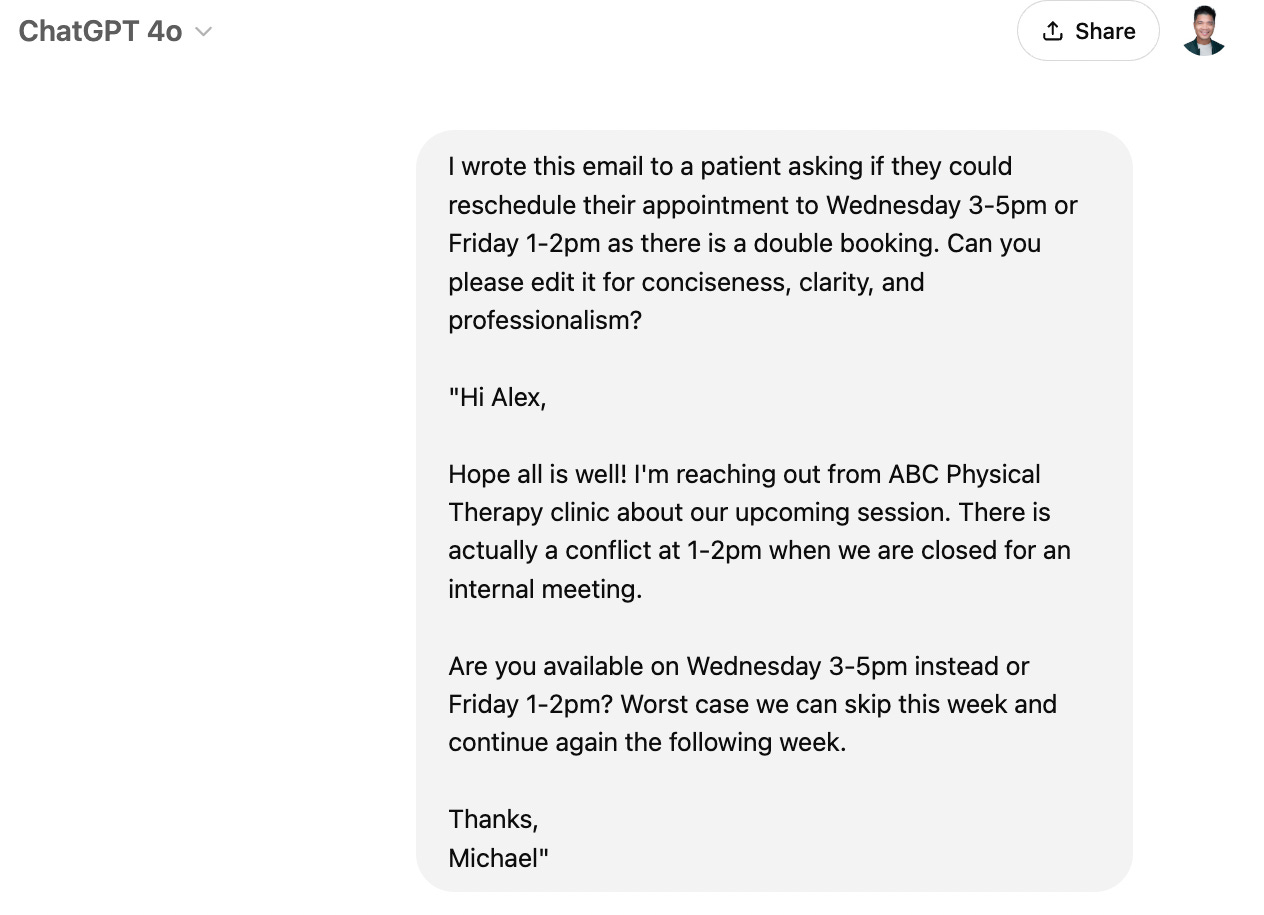
Furthermore, if the owner or employees spend significant amounts of time writing documents, they can give AI:
Some context about the purpose of the communication (e.g., requesting payment, customer support, or scheduling).
A few bullet points outlining the key points to include (no polish needed)
And ask it to produce a document incorporating these points in the format they expect.
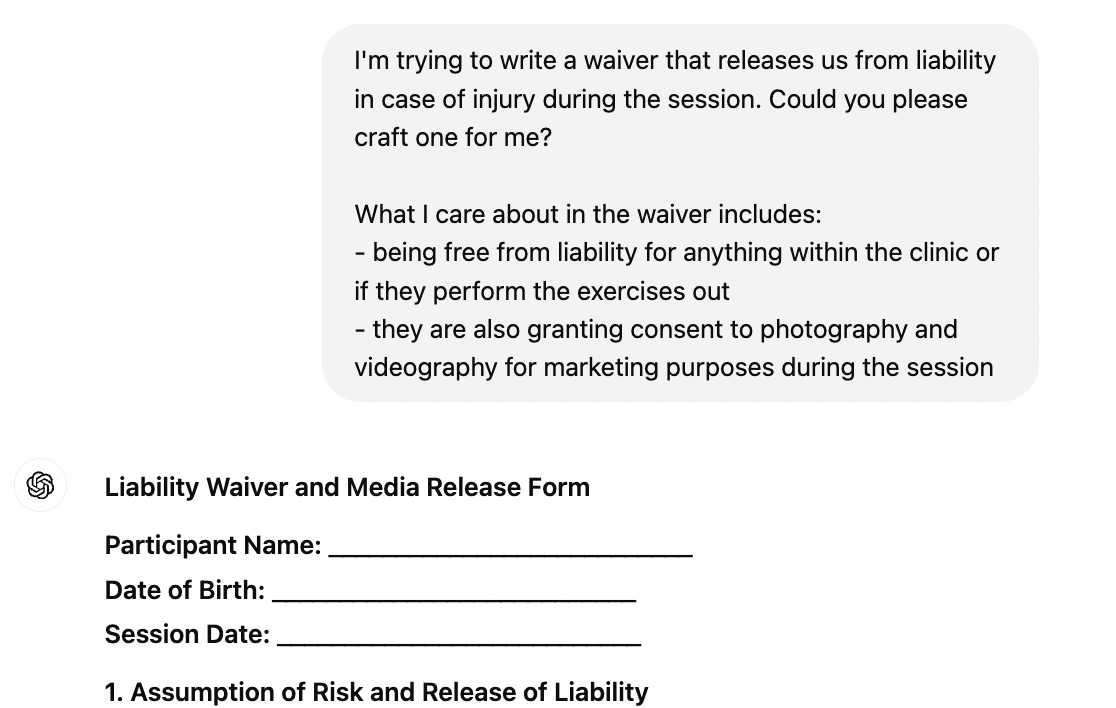
Notice how AI is able to produce an entire document that we can copy paste and send in seconds, saving time and money.
Leveraging AI Note-Takers
AI note-takers are also an easy win that I would recommend they implement immediately.
These note-takers are like bots that attend meetings, record transcripts, and send out summaries and action items to all meeting attendees after.

They’re important because they’re genuinely useful - many clients have thanked me for my AI generated notes.
They also create the “aha” moment for AI adoption.
For many employees, AI note-takers are their first real interaction with AI—and it’s a powerful one.
Seeing AI improve their workflow firsthand builds excitement and momentum for larger AI initiatives.
I've evaluated several AI note-takers and settled on using Fathom. However they’re all pretty similar in feature set, so it’s really a personal preference at this point.
Using AI to Improve Service Delivery
The second area where AI can also assist with is patient care.
Physical therapists can pass in client details like height, gender, and age, their symptoms, and ask AI questions to help with:
Diagnosing issues
Recommending exercises
Answering patient questions
For example, they could have a prompt like:
“A patient of mine is 24, female and 5’5”. They came in with radiating pain around their elbow. They can extend it fully but have trouble rotating it. They were an athlete and sustained this injury when they fell on it during a match. What could be the root cause of this issue?”
Since health is particularly sensitive, I recommend using two different models, like Claude, ChatGPT, or Gemini, and passing the same prompts to both to compare answers.
This gives you different perspectives that any one model may have missed.

Using AI to Provide Feedback for Key Decisions
Many small business owners, particularly solo entrepreneurs, often lack a structured system for gathering and analyzing feedback.
AI can bridge this gap by providing insights across a range of areas—from financial analysis and operational improvements to evaluating past interactions for better outcomes.
For example, the owner mentioned several challenging client interactions.
Instead of speculating on what could have been done differently, you can tell AI to review these situations and offer actionable suggestions for improvement.
If improving financials is a priority, they can collect key data such as hourly rates, weekly bookings, top-line revenue, bottom-line profits, and other critical financial metrics.
With this information, you can upload this to AI to uncover trends, recommend cost-saving strategies, or opportunities to boost revenue.

Final Thoughts
Implementing AI doesn’t have to be complex.
By understanding the AI landscape and using existing tools wisely, small businesses can achieve significant benefits with minimal investment.
As these tools are adopted, consider upgrading to a team plan for enhanced data protection and to ensure sensitive information remains secure.
Most importantly, always keep a human in the loop.
AI is a powerful tool that supports your expertise and judgment, but it’s not a replacement.
By taking these steps, any small business can confidently embrace AI and unlock its transformative potential.
💡 Need Help with AI Implementations?
Feel free to contact us at our website here for a free 30-minute consultation.
If you know someone who needs help with AI, refer them to us and receive a $1,000 award.
And if you liked this article, follow me on LinkedIn for daily, revenue impacting AI content.
Our company LinkedIn page is here.